
Are you unable to tolerate CPAP? Does increasing your CPAP pressure make your sleep worse, maybe even causing you to choke? Today, the Journal of Clinical Sleep Medicine published our sleep apnea surgery research that may explain why this happens in some patients and how sleep apnea surgery can help.
DISE-PAP as a tool to guide sleep apnea surgery
My career has focused on obstructive sleep apnea surgery, so I mainly care for patients with obstructive sleep apnea who cannot tolerate positive airway pressure therapy (I often refer this as CPAP, although there are other types). In general, we two potential goals when we develop a tailored treatment plan that often includes sleep apnea surgery. One is sleep apnea surgery (typically involving surgery of the throat) to control or resolve the obstructive sleep apnea. The other is sleep apnea surgery (often limited to the nose) to make CPAP more comfortable. Our research may force me to modify one of these goals.
Drug-induced sleep endoscopy (DISE) is a sleep apnea surgery evaluation performed in the operating room. This involves looking through the nose and into the throat to see what is causing the physical blockage of breathing in obstructive sleep apnea, as sleep apnea surgery can address various physical causes. DISE is a central part of how I make decisions with about sleep apnea surgery that might be best. I have performed DISEs since 2003 and have published numerous research papers, but in the past few years I have started administering CPAP during DISE (so-called DISE-PAP). During DISE-PAP (which I did not develop myself), I can watch to see how CPAP opens the throat at various CPAP levels. There is some limited evidence to suggest that full opening of the throat at low CPAP levels may be associated with better sleep apnea surgery outcomes, and we are examining this and other potential findings closely as part of our sleep apnea surgery research funded by the National Institutes of Health.
CPAP can cause airway obstruction related to the epiglottis
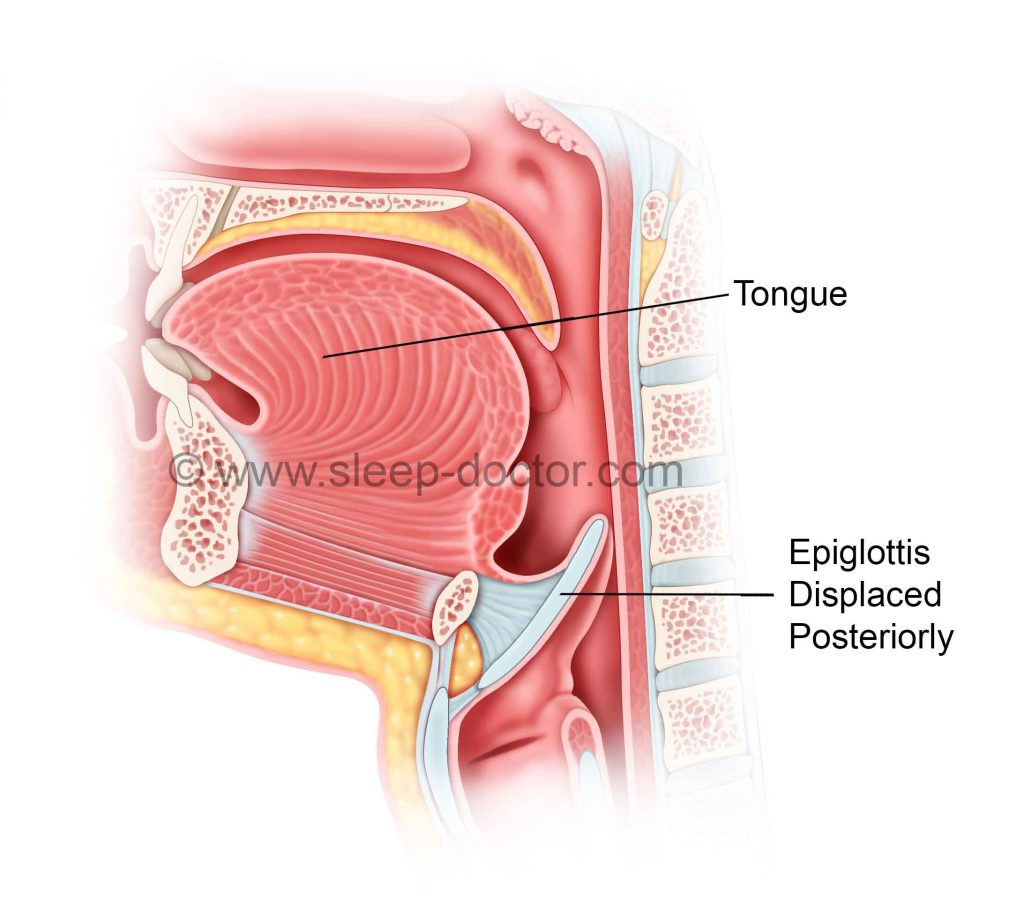
The traditional thinking is that CPAP opens the airway by functioning as what is called a pneumatic splint, with greater CPAP levels causing greater airway opening, similar to blowing on a balloon and inflating it with more pressure. This is exactly what I see in most of my sleep apnea surgery patients during these DISE-PAP exams. However, over time I began to see sleep apnea surgery patients in whom greater CPAP levels actually caused airway obstruction! In these patients, it seemed that high CPAP levels almost pushed the epiglottis backwards to decrease the ability of CPAP to deliver normal breathing.
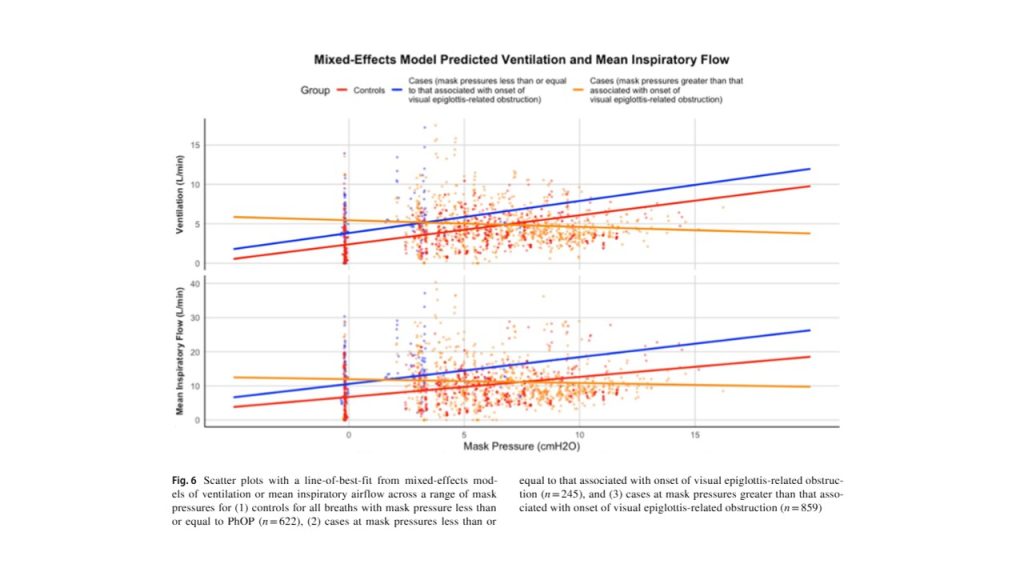
We decided to study this systematically by having a consecutive group of 150 study participants undergoing DISE as part of a sleep apnea surgery evaluation because they could not tolerate CPAP. Once they completed their main DISE evaluation without CPAP (the primary evaluation that we use to develop sleep apnea surgery plans), we administered CPAP at pressures up to 15 cm of water (a high but not outrageous pressure). We had one group of 26 cases, all of whom either had epiglottis-related obstruction before CPAP or developed this during the DISE-PAP portion of the study. We compared this to 14 matched controls from the enitre group (some cases did not have similar controls). What we saw was that 19 of the 26 cases (13% of the entire group and all men!) had an increase in airflow and airway size up to a CPAP level where the airway was open, with a decrease in airflow and airway size as the pressure was increased even further. These changes at greater CPAP levels were associated with the epiglottis was moving backwards to block breathing. This decrease in airflow and epiglottis-related obstruction was not seen in the other cases or the controls. Figure 6 from the paper is presented below, but you can see the entire article posted by the Journal of Clinical Sleep Medicine online.
What does this mean for sleep apnea surgery?
This phenomenon of CPAP inducing epiglottis-related obstruction has been noted by others but has not been studied in a large, detailed evaluation like this. There are a number of implications, including one that might represent a new potential goal of sleep apnea surgery:
- This may provide an explanation for one reason patients do not tolerate CPAP and consider sleep apnea surgery. This worsening of airflow and epiglottis findings were seen in 13% of these individuals who did not tolerate CPAP, so it may not be unusual.
- This pattern was only seen in men, similar to the greater risk of epiglottis-related obstruction in men.
- This may explain why some patients seem to have worsening of their sleep apnea at greater CPAP levels, even when receiving CPAP under careful monitoring in the sleep lab. My patients considering sleep apnea surgery tell me often that they will sometimes wake up choking in the middle of the night, with or without CPAP, and in those patients the epiglottis is, more often than not, a source of airway obstruction during DISE (even without CPAP).
- Epiglottis surgery theoretically could be performed not only to alleviate sleep apnea but also to improve CPAP effectiveness by preventing CPAP-associated epiglottis-related obstruction.
The last point deserves special discussion for anyone who does not tolerate CPAP and looks at possible sleep apnea surgery. Before rushing into sleep apnea surgery, I always have a long discussion with my patients about why they have not tolerated CPAP. Sometimes there are easy problems to fix with adjustments or medications without needing sleep apnea surgery at all. When a patient reports that nasal obstruction is preventing them from being comfortable with CPAP, my evaluation may provide clues as to how best to address this; in some cases we perform nasal surgery that can make all the difference in CPAP use. This paper suggests that DISE-PAP may be important in identifying those at high risk of CPAP-associated epiglottis-related obstruction, especially if we can treat and improve it with sleep apn. This high-risk group may be those with epiglottis-related obstruction or a history suggestive of possible epiglottis-related obstruction, such as choking during sleep with or without CPAP. In the years before I started performed DISE-PAP exams, I had a few (but just a few) patients who had epiglottis-focused sleep apnea surgery for exactly this purpose, and, I must say, they ended up very happy because they could now tolerate CPAP and did not have to consider other types of sleep apnea surgery.
The study has some important limitations, above and beyond the fact that this was seen during DISE and not natural sleep. One is that we observed CPAP-associated epiglottis-related obstruction in men only, and it is unclear whether it also occurs in women (we did have many female patients, but none had this phenomenon). Second, the measurement of airflow was not perfect because, at greater CPAP levels, in some cases there was mask leak. Third, the CPAP levels associated with the decrease in airflow were greater than might be required for these patients in natural sleep, so the findings may not be clinically meaningful as often as we saw in the study protocol. Finally, the value of treating the epiglottis (such as with epiglottis-focused sleep apnea surgery) in these individuals is unknown. In spite of these acknowledged limitations, the findings were meaningful enough to be published in one of the top sleep journals in the world.
Will I be performing more epiglottis-focused sleep apnea surgery?
There are many epiglottis-focused sleep apnea surgery procedures. These range from removal of a portion of the epiglottis to the epiglottis stiffening operation. It is unclear how other types of sleep apnea surgery address epiglottis-related obstruction, but there are some sleep apnea surgery procedures that likely do indirectly treat epiglottis-related obstruction. Hyoid suspension is a sleep apnea surgery that moves the hyoid bone forward, and the effect on the epiglottis is related to the hyoepiglottic ligament that pulls the epiglottis forward as the hyoid bone itself is placed in a forward position and held in place. Hypoglossal nerve stimulation – whether the Inspire Upper Airway Stimulation or the Nyxoah Genio – is another category of sleep apnea surgery that may directly or indirectly move the hyoid bone forward, achieving similar indirect effects on the epiglottis.
As for my possibly doing more epiglottis-focused sleep apnea surgery, I like to think that I discuss potential sleep apnea surgery treatment plans with patients based on their unique situation, whatever that may dictate. That being said, I do think that DISE-PAP has offered new insight into possible sleep apnea surgery approaches. In some cases, it could make offer less-aggressive sleep apnea surgery like epiglottis surgery to improve CPAP comfort instead of more-extensive sleep apnea surgery designed to address sleep apnea without the need for CPAP.

 Santa Monica Office
 Beverly Hills Office



41 − = 32