
Patients ask me often, “What is the best sleep apnea surgery?” That is a TOUGH question to answer. In my opinion, it is a fair question but not really the right one. A better question would be, “What is the best surgery for me?” or “What makes one surgery better or different than another for me?”
The most-effective sleep apnea surgery is placement of a tube directly into the windpipe (trachea), a procedure called a tracheotomy. A tracheotomy treats obstructive sleep apnea by establishing a separate pathway for breathing directly into the lungs, bypassing any blockage in the nose or throat. That being said, but I have never performed tracheotomy as a long-term sleep apnea treatment.
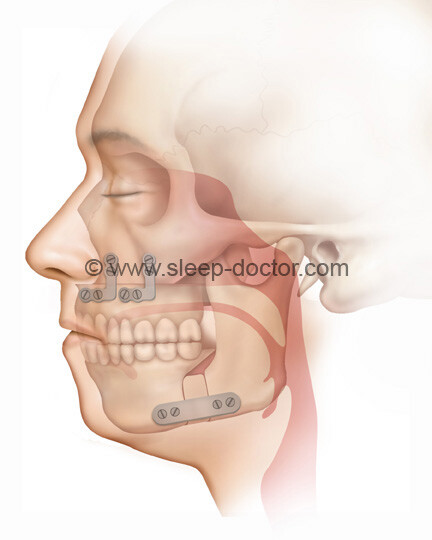
Aside from tracheotomy, the most effective sleep apnea surgery involves moving the jaws forward, a procedure called maxillomandibular advancement. This is actually a combination of two procedures because it involves movement of both the upper and lower jaw, often with some rotation of the jaw that can improve the change in appearance that occurs for some patients. Maxillomandibular advancement affects both the Palate Region and Tongue Region, making it effective in many patients, especially those with small or narrow jaws or those in whom the jaws are positioned towards the back of the throat.
New research about maxillomandibular advancement
I used to perform maxillomandibular advancement but stopped doing it because I felt I was not doing it often enough to have the same experience and expertise that colleagues (often oral and maxillofacial surgeons) do with this type of sleep apnea surgery. Maxillomandibular advancement worked well in my patients, but over time some have argued that it should be the only sleep apnea surgery that is performed. I could not disagree more, as this ignores the important strengths and weaknesses of this procedure for sleep apnea surgery.
Does maxillomandibular advancement work?
Two recent studies of maxillomandibular advancement have evaluated key questions important in any decision about surgery. The first study addressed effectiveness: “How well does it work?” and “What patients are more likely to get the best results?”. The authors reviewed the available studies on maxillomandibular advancement for sleep apnea, combining the data across studies using a process called systematic review and meta-analysis. While the individual studies have many limitations, including what is called publication bias (surgeons are more likely to publish good results than bad, an issue with all medical research), systematic review and meta-analysis is supposed to combine the available data in a structured way to identify bias.
The study found that the success of maxillomandibular advancement for sleep apnea decreased with greater patient age. Translation: maxillomandibular advancement works better in younger patients. Importantly, there appears to be no difference in results for women versus men. This finding agrees with my own experience and those of my fellowship directors (Nelson Powell, MD and Robert Riley, DDS, MD) that pioneered the use of maxillomandibular advancement for sleep apnea.
What about the risks of maxillomandibular advancement as sleep apnea surgery?
This brings us to the other that addresses the other side of the sleep apnea surgery risk-benefit calculation: the risks. The same colleague (Mohamed Abdelwahab, MD, PhD) led a similar type of study (systematic review and meta-analysis) comparing risks of maxillomandibular advancement as sleep apnea surgery to the same type of surgery performed for dentofacial abnormalities. The study suggested that maxillomandibular advancement for sleep apnea surgery was associated with increased risks of infection (16% vs. 4%) and hardware removal (22% vs. 4%) but no difference in neurosensory deficits like numbness (40% vs. 45%).
Why does maxillomandibular advancement for sleep apnea have greater risks than when performed solely for dentofacial abnormalities? There are likely multiple reasons. First, maxillomandibular advancement for sleep apnea requires greater movements of the jaws, making bone healing more difficult. Maxillomandibular advancement involves cutting the bones of the upper and lower jaws. Bone healing depends on healing of bones in their new positions after movements of the bones, and greater degrees of bone movements provide less contact of the bones in their new position and therefore make healing more difficult.
Second, the greater movements of maxillomandibular advancement for sleep apnea can places nerves on more stretch, and nerves generally do not like being stretched. While nerves are freed up to miimize stretching with the procedure, there is often some amount of stretch that occurs. Lastly, maxillomandibular advancement for sleep apnea not only typically has greater amounts of bone movement but also is performed in patients who have greater muscle mass that applies greater force on the bones as they try to heal. As compared to maxillomandibular advancement for dentofacial abnormalities, maxillomandibular advancement for sleep apnea may require placement of thicker, longer metal plates and screws to help support the bones during the initial healing process. All of these can contribute to a greater risk of needing another procedure for hardware (metal plates and screws) removal.
Again, this study’s findings agree with my own experience for risks of maxillomandibular advancement for sleep apnea, both in my own patients and patients I have seen over my career. What was missing from the study about risks was an examination of potential associations between patient age and complications (and recovery from complications). This would have been nice because every surgeon I know who performs maxillomandibular advancement for sleep apnea has seen that younger patients have better bone healing (lower risk of infection) and nerve recovery (from neurosensory deficits).
The bottom line: who are the best candidates?
It has long been clear that the best candidates for maxillomandibular advancement for sleep apnea are younger patients, especially those with dentofacial (upper and/or lower jaw) abnormalities. These two studies have added to the evidence confirming that these patients have the greatest benefit while also showing that there are non-trivial risks. Importantly, these younger patients likely also have lower risks (not specifically shown in these studies but consistent with widespread experience).
The full importance of these studies is that they contribute to our understanding of how best to develop a surgery treatment plan appropriate to individual patients rather than having a single procedure for all. Maxillomandibular advancement is an important sleep apnea surgery, but it is not the right surgery for all patients.

 Santa Monica Office
 Beverly Hills Office



3 + 1 =